KISMET
SUSPEND YOUR DISBELIEF
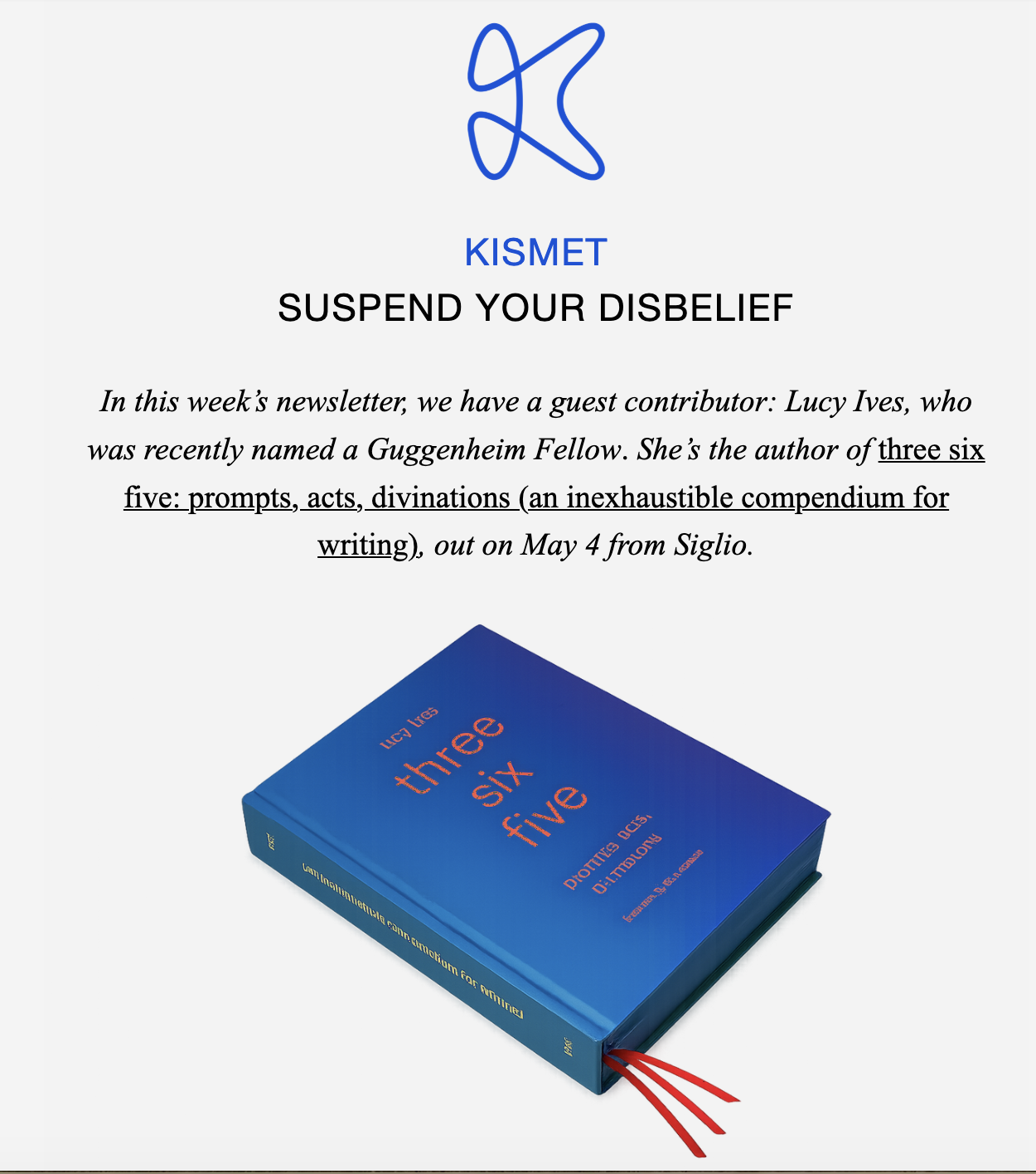
In this week’s newsletter, we have a guest contributor: Lucy Ives, who was recently named a Guggenheim Fellow. She’s the author of three six five: prompts, acts, divinations (an inexhaustible compendium for writing), out on May 4 from Siglio.
As a writer who has taught on and off for over a decade, I’ve spent a fair amount of time thinking about how people begin writing. I don’t mean this in the sense of, “I’ve decided to be an author!” I’m talking on a phenomenological level. I mean the moment when a person makes the choice not just to pick up a writing implement (or fire up Microsoft Word), but the instant they move out of whatever everyday habits of reflection and more or less conscious relationships to language—to something else. I’m talking about the interval when a human mutters to themselves, “What is the first letter of the first word that has to be written so I can write what I mean?” This apparently minor transition can fly by so quickly that you don’t notice it, or it can stump someone for days.
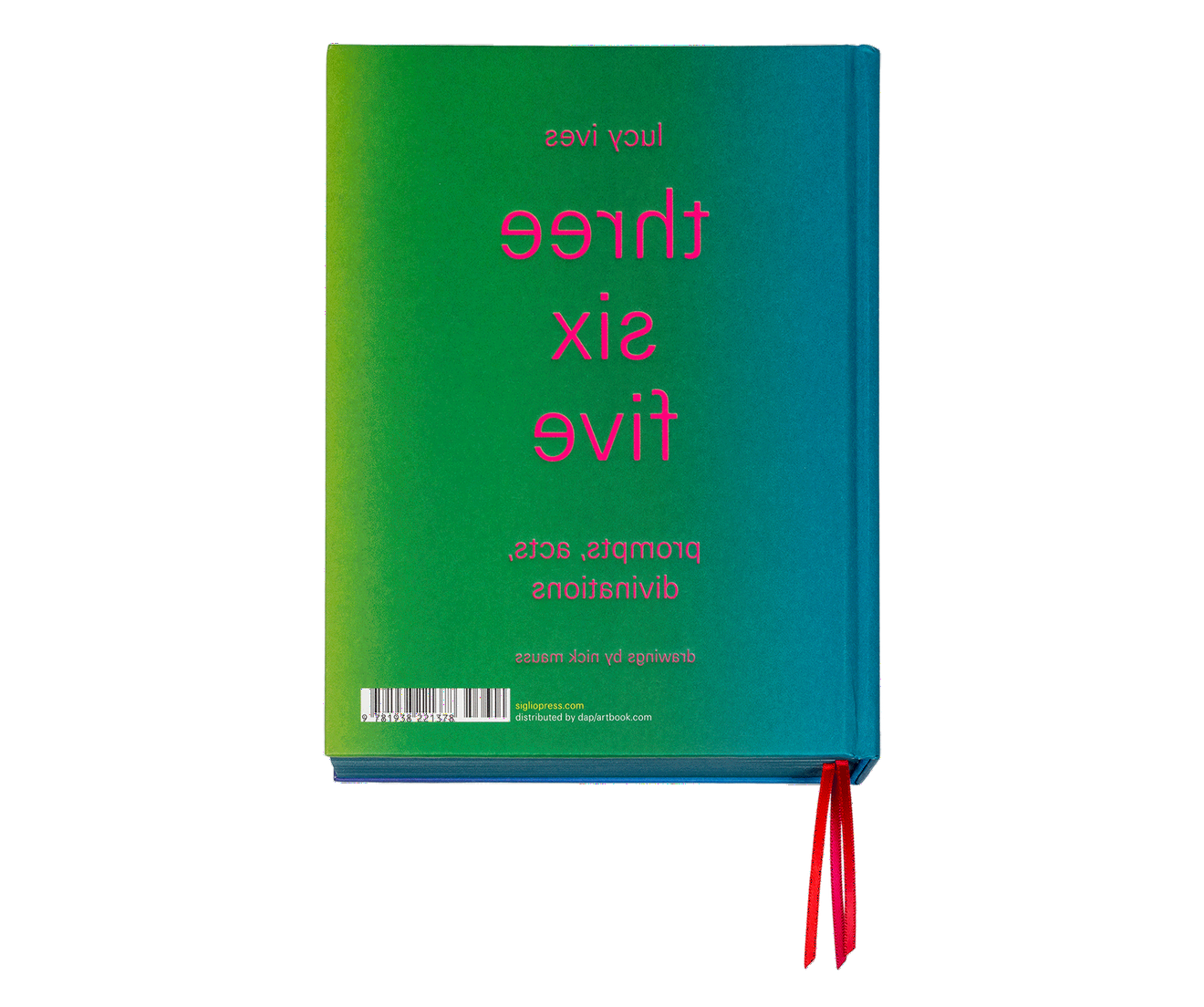
One of the ways I’ve puzzled over this widely experienced but little described feat of mental, linguistic, and technical ingenuity—the act of beginning writing—is by composing short exercises that suggest ways of treating this strange interval as a kind of material. In this project, I’ve had quite a few willing test-subjects, inclusive of participants in classes I’ve taught, plus myself. Over time, a certain quantity of these prompts, divinations, and/or meditations have accrued. Recently, I had the opportunity to organize 365 of them into a book, ask the artist Nick Mauss to create illustrations inspired by them, and publish the collection in collaboration with editor and book-designer extraordinaire Lisa Pearson on her imprint, Siglio Press. The result, three six five: prompts, acts, divinations (an inexhaustible compendium for writing), is something like a modern book of hours, something like a year-long calendar or clock, something like a cycle of very short stories in which the reader is both narrator and protagonist, something like a work of philosophy. (Maybe it’s a guide to writing, too.)
Most of all, I hope it is a kind of anatomy of human intuition. As I write in the book’s introduction, “I really believe that writing is related to survival and, more specifically, to the survival of intuition. This is the survival of that which cannot be fully assimilated—as information or truth. Intuition is, additionally, a human thing that is not scarce and cannot become scarce, even amid the most tyrannical austerities. Intuition is previous to institutional forms. It’s occult, which is to say, a recessive feature of human agency. Its exercise is not direct. It entails guessing, faith, risk, patience, cunning, awe, doubt, trust, hope, mystification, uncertainty, acceptance, and occasionally doing nothing at all (among other modalities). You have not forgotten intuition, although you may have learned that you did. Please find in this book some suggestions for how to unlearn this forgetting, should that be your wish.”
This is probably all that needs to be said before I turn you over to three exercises from three six five selected by the editors of Kismet for your amusement and delectation. The only thing I’ll add is that the other major ingredient in writing that interests me is memory. With apologies to Plato, I concur with the late poet Lyn Hejinian that writing is “an aid to memory.” Every exercise here is an opportunity to imaginatively “place” information or words in specific (virtual) sites, where they can be more easily recollected, as in the ancient memory place technique. Every exercise is also a (tiny) labyrinth. I welcome you in.
—Lucy Ives
Psychic Bibliography
Create a bibliography related to a mood, affect, feeling, desire, wish, passion, obsession, or other personal or interpersonal sensual and/or emotional tendency. This might be a famous concept like embarrassment or apathy, or it might be something rarer or more specific and minor, like a jealousy of people who are more reckless than you. Who claims expertise in this? Has anyone written about this before and, if so, how?
See where this bibliography carries you.
In Memory of My Feelings
Make a personal timeline of all your life’s secrets—secrets regarding yourself, especially, but also secrets you have kept for others, as well as secrets you may not have kept or had to keep, but knew about, all the same.
Date the secrets, paying particular attention to their inception and their conclusion, if such things exist.
You might also rank them by size, level of devastation, unwieldiness, deliciousness; place them in alphabetical order; index them; and so on.
Continue to work on this document until a new path becomes clear.
The Sentence Is Present
This is an exercise for finding a lost or neglected experience that may be very near to hand. It takes hold of the present and cracks it open like a geode. If you don’t believe me, try it.
Set a timer for 10 minutes.
Now respond to each of the following prompts for two-minute intervals, writing with as much detail as you can as you can:
5 minutes ago, I was thinking…
4 minutes ago, I was thinking…
2 minutes ago, I was thinking…
1 minute ago, I was thinking…
5 seconds ago, I was thinking…